This week, Vitalis made progress in integrating a camera with our prototype, and worked an OCR (Optical Character Recognition) system for reading patient data. Additionally, the team completed iterating on the design of our chassis. This culminated another print of our chassis, in preparation for usability testing! This print can be seen in the image above. We had prepared to go to a code simulation event at the PICU (Pediatric Intensive Care Unit) at UF Shands but, we had to reschedule due to events outside our control.
Vitalis is excited to have a great first chassis iteration and plan to begin testing at Shands in one of their ICUs during a faux code call! Our first iteration features an easy to use interface and with a small scale network to handle non-local computation of clinician transcriptions! Currently, we are seeing that our device can support 6 hours of uptime when disconnected from wired power, relying solely on the battery pack! This is a crucial functionality we are working towards to ensure that we have the highest possible availability, including during a power outage.
Along with the developments of the chassis, Vitalis has also decided on a single database schema that allows us to unify necessary details to organize user recordings, ICU information, and HIPPA-necessary audit logs.
Lastly, our IaaS provider has gotten back to us and has given our software subteam the capability to access their resources and create VM instances that will manage the external computing after we have working local systems.
The week of January 30th was packed for team Vitalis! First, on Tuesday, the team defended their current design implementations/self-ratings in various categories in front of a panel of judges. Our team planned accordingly and did our very best, and we’re proud to say that we’re more than on track in most objectives; not that we’re surprised!
Additionally, our week has arrived at an exciting conclusion with the arrival of our very first Chassis! The Chassis was manufactured using the Stratsys F370 industrial-grade printer in ASA material. We plan to begin validation testing with the new device components within the next week. After that, we plan to head back to the SIM lab at Shands to conduct more in-depth tests and make sure our device is optimized for the hospital setting. We’re so excited to begin finalizing our year-long project!
Last week, the team mapped out our goals for the next few months—and it’s an ambitious plan! Even in just Week 1, Vitalis has started off strong making significant progress on both the hardware and software sides of the project.
On the hardware front, the team is making headway on chassis_v2, alongside taking battery measurements and executing calibration work. This week emphasized the importance of design inputs, tolerances, and user needs—key factors that directly shape the chassis design. Some of the design considerations we hadn’t thought about before include, ensuring the handle is easy to grab one-handed without interfering with the camera and microphone, orienting the Pi and fan vertically to promote airflow, and positioning components to minimize wiring and protect sound quality. The team is also considering gasketed seals for the microphone and LCD to prevent water ingress, optimizing camera and screen angles for ease of use, and adding a physical safeguard to the shutdown button. Together, these considerations are shaping how the device will ultimately be assembled and used.
Screenshot shows chassis_v2 in progress!
Meanwhile, the software sub-team is taking multitasking to the next level. They’ve already developed proof-of-concepts for the QR scanner, touchscreen UI, and encryption system. Huge credit to the software team for working efficiently in parallel while maintaining clear communication within the sub-team and with hardware.
As prototype development continues, Vitalis is also preparing for QRB 1 (Qualification Review Board). During this review, the team will present current achievements, next steps, and potential project risks to a panel. We’re excited to receive feedback, identify areas for improvement, and uncover any shortcomings before moving forward to QRB 2.
Team dinner post class at Pokebowl StationTeam mascot: Luna
The team had a very refreshing winter break and is ready to continue developing the prototype! The main action item for this week was to coordinate meeting times with everyone’s schedules and hash out goals for the semester. Alongside this, more testing was conducted on the prototype the team developed during fall to catch possible mistakes that may arise in the final product.
The team decided tasks for each subteam to complete by mid February in order to remain on time and provide ample time for testing. We’re looking forward to a great semester and to develop a strong product!
This week a portion of our group which to the UF Simulation Lab to learn about Code Blues and how they’re run. We received a lot of valuable information and feedback from medical students who were participating in the training. We’ve continued to make progress on the software and hardware sides, mainly focusing on failure testing that we will conduct. We look forward to the SLDR Presentations after break!
This was a packed week for Team Vitalis! Most of our focus was on preparing for the upcoming System Level Design Review, but that didn’t mean that work on our prototype had stopped. Software-wise, we were able to get diarization working with our prototype. We also conducted research for the material choices of our final design. Finally, we had a meeting with an external advisor, where we got a better understanding of the regulations surrounding medical devices.
After an intense couple of weeks of preparation, Vitalis participated in IPPD’s Prototype Inspection Day event in the Rion Ballroom last Tuesday. Upon activating our prototype, a recording session from our edge device was able to begin collecting audio data. After recording, our prototype was able to send it to an external server (Matthew’s Laptop) for transcription synthesis upon conclusion. One finished the transcript was sent back and was able to be read from the prototype’s monitor.
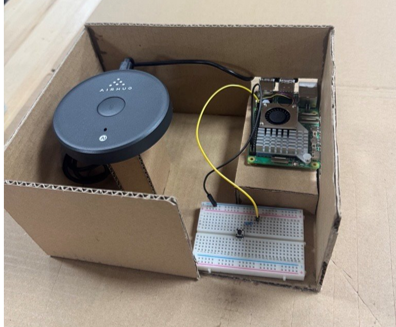
Here is a picture of our edge device.
The whole team was happy to receive feedback on our prototype from faculty working in AI and BME. The input we were given gave us new considerations to be conscious about moving into our next major event, SLDR.
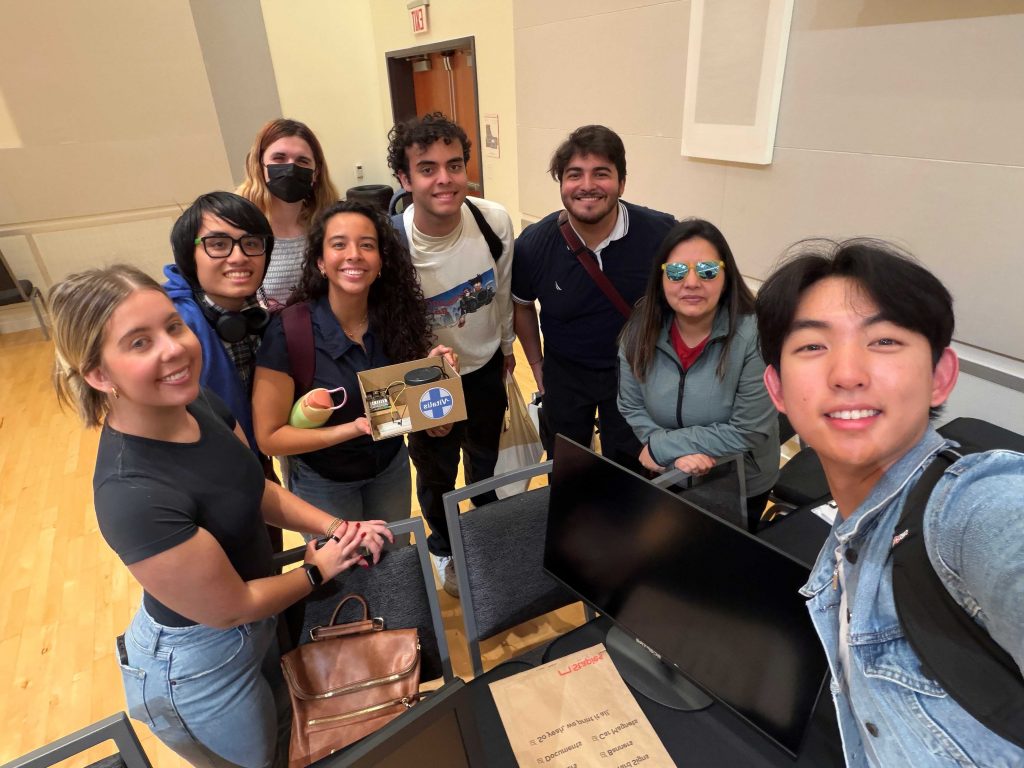
Here is a picture of the whole group at Prototype Inspection Day. From left to right we have Aizlyn Potter (ME), Huy Nguyen (CpE), Julia Leser (BME), Julianna Gonzalez (BME), Daniel Saurez (CS), Ezequiel Medrano (CS), Dr. Laura Cruz Castro (Vitalis coach), and Matthew Li (CS).
Moving forward, in addition to preparing for SLDR, We are all very excited to begin adding more components that will be present in our final design. we hope to deliver a new chassis, begin working on our GUI, decide on and implement an E2E encryption method, and bring our team to UF’s Center for Experiential Learning and Simulation Lab to gain a better understanding of ICU environments and code blue calls.
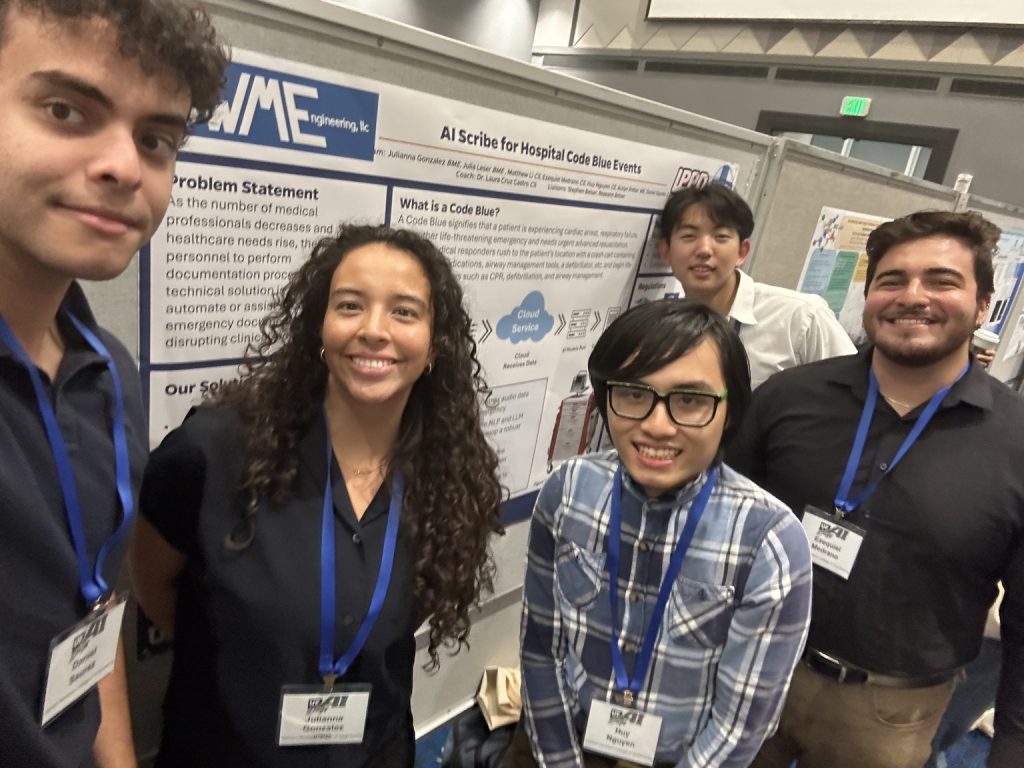
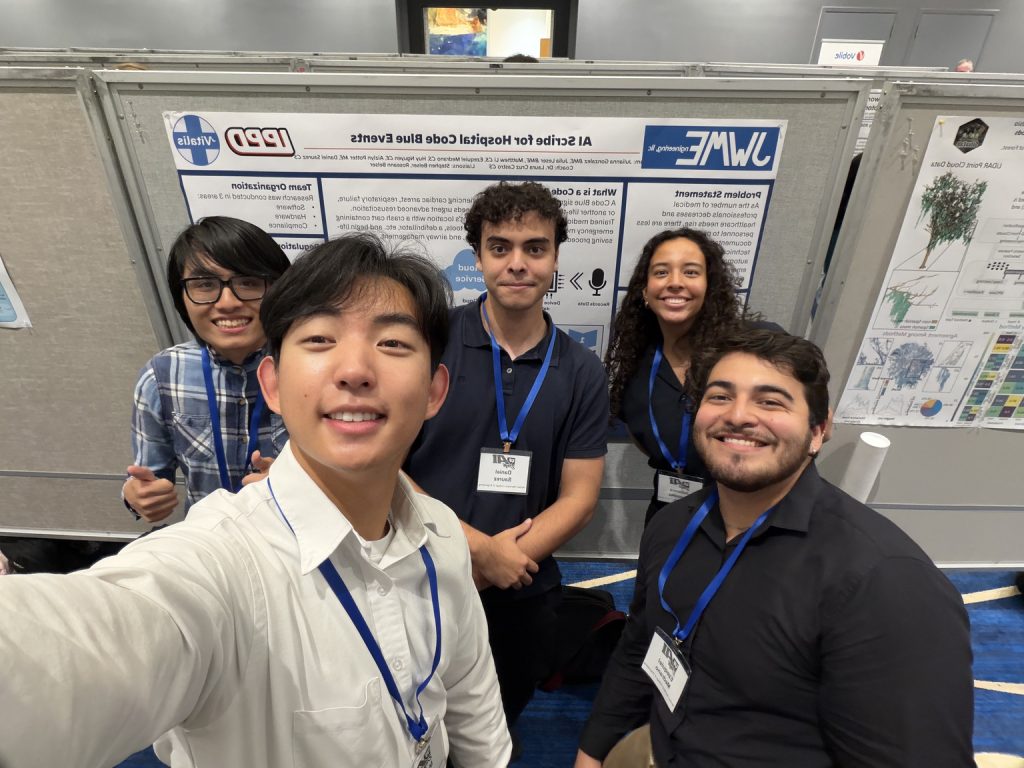
We first presented for UF AI Days – which occurred on Tuesday Oct 28th from 5:00-6:00 PM. In order to adequately prepare, we created a Presentation poster which required input from our liaisons as to what could be publically presented from our NDA. We also prepared speaking parts for each member for the actual presentation!
Here is a photo that we have from the event!
We’ve also been able to make progress on prototyping from a software and hardware side. We’ve been able to begin utilizing the processor in conjunction with the purchased microphones as well as testing external server API calls with AI model transcriptions! Currently we are preparing for our Prototype Inspection Day on November 4th, and will provide update after the event with any feedback!
Very exciting developments were made this week from everyone on team Vitalis! Our software team has developed a preliminary partioning system to break up recorded data into smaller pieces for more complete recording and processing. Additionally, we have selected a preliminary model for summarization of the recorded material, which we will begin testing soon!
Additionally, our Hardware sub-team has completed a preliminary design for the prototype chassis to be presented on Prototype Inspection Day (11/04). While very barebones at the moment, we plan to make vast improvements based on the feedback we recieve from professionals, students and stakeholders who will be examining our design in depth, among those of all the other IPPD teams!