Hey crew!
We’re rounding out Week 10 with some heavy‑lifting in prep for the prototype inspection day. This week’s highlights:
The Krging that makes the world spin
Dr. Lind presented a short lecture on surrogate based modeling, called kriging. This will be utilized to make a design space with our variables. We still have a lot to learn regarding this process and are excited to pursue this subject further!
We also have begun brainstorming potential cost functions and editing the Kriging code to account for all of our variable changes in both the inputs and the outputs. This will all be done to further our prototype for PID this upcoming Tuesday!
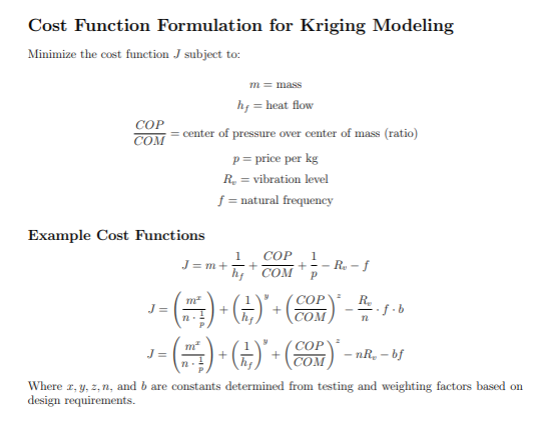
The image above shows the cost functions we are starting to develop; they quantify how effective our design is at achieving controlled demise during reentry by combining key physical and performance variables into a single metric, J, that can be minimized. Each term represents a tradeoff among competing objectives: lower mass reduces orbital debris risk, higher heat flow promotes structural failure, and the ratio of the center of pressure to the center of mass (COP/COM) influences aerodynamic stability. Additional factors such as price per kilogram, vibration level, and natural frequency capture manufacturability and mechanical resilience.
The nonlinear exponents and constants in the equations weight these parameters based on their importance to design requirements, allowing the Kriging model to predict how changes in geometry or material affect demisability. In short, minimizing J identifies configurations that are lightweight, thermally responsive, and physically tuned to fail safely upon atmospheric reentry, meeting the core goal of the Design for Demise project.
Fresh Air – The Great Outdoors Session
The weather turned out fantastic, so we moved the Thursday meeting outside. Fresh air lifted the mood and sparked a few creative ideas with how we will present our prototype on PID on Tuesday!
Visually
Updated CAD files now are able to be 3D printed and run through ANSYS Fluent. A preliminary ANSYS Fluent model has been conducted to familiarize ourselves with the tool and prepare for more complex modeling.
Thanks for the great collaboration, and let’s keep the momentum going in next week for SLDR Prep!