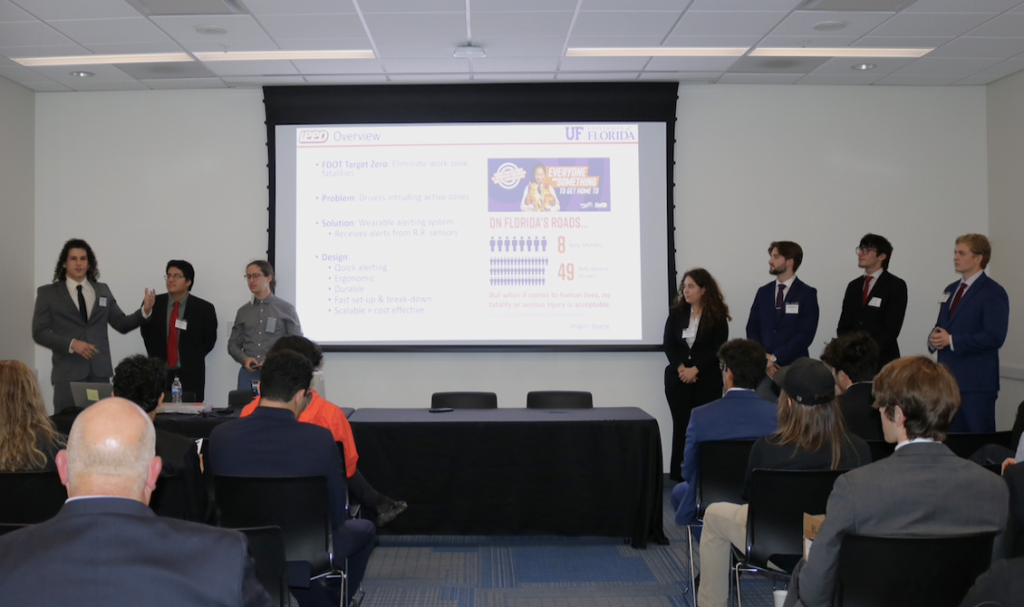
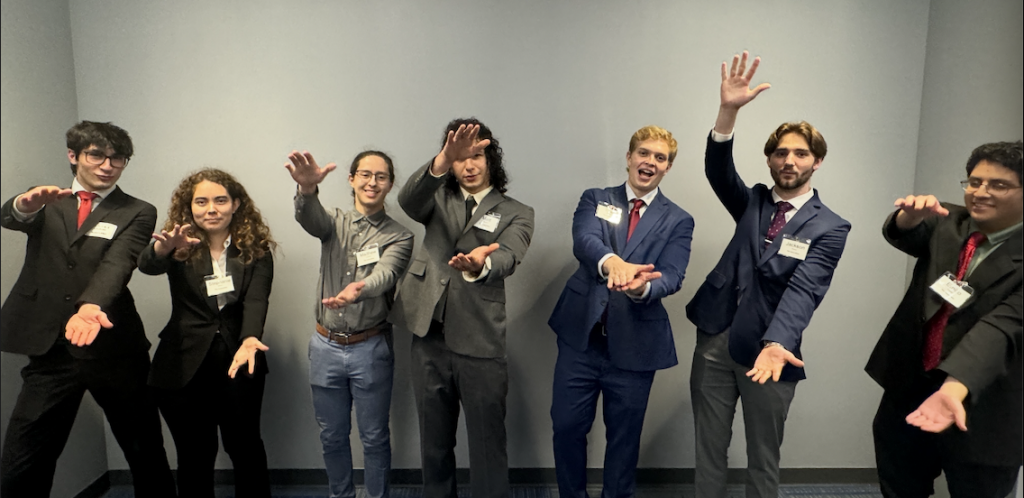
This week, we gave our System Level Design Review presentation to an audience filled with our liaisons, sponsors, and other students and IPPD faculty. It has been a long and challenging semester, but it felt great to step up there as a team and give our halfway presentation for the project we’ve already spent many nights staying up late and tired to ensure its success.
Thank you to our liaisons Lee Woodcock, Bertho Augustin, Camila Garcia-Ferryra, our sponsor Jordan Green at FDOT, and everyone else who has helped us along the way and shown us guidance. We are excited to get started on building next semester!
This week, our team made significant progress as we moved closer to the System Level Design Review (SLDR). We finished the draft of the SLDR report and presentation, summarizing our system architecture, prototype functionality, and overall design direction. With the core content prepared, we participated in the SLDR peer review, where we delivered a full presentation and demonstrated the current capabilities of our prototype. The feedback we received from peers was constructive and helped highlight areas for improvement before the formal review.
Alongside presentation work, the team continued developing supporting documentation, including the software design description, functional description, and interface specifications. We also finalized the manufacturing plan for large-scale hardware production and completed the outline for our electrical and mechanical testing procedures. These components will guide the next stage of development as we transition from early prototyping into more structured evaluation.
Looking ahead to the next week, our focus will shift to refining the SLDR presentation based on peer feedback. The team plans to restructure several slides to highlight device capability, project risks, and quality objectives while reducing text in favor of visuals and demonstrations. We will also begin practicing the presentation in person to finalize timing and ensure smooth transitions between sections.
Overall, the project remains on schedule, and the progress made this week has positioned us well for a strong showing at the upcoming SLDR.
This week, our team continued refining the details of our system as we prepare for the upcoming System-Level Design Review (SLDR). We updated the hardware description, electrical interfaces, and housing considerations to ensure everything stays aligned with our system requirements. As material options became more defined, we also started thinking about how those choices would influence component placement, wiring paths, and general protection of the internal electronics.
A major focus for the team was beginning our prototype and experimental testing plans. We outlined the tests needed to verify core functions such as alert behavior, power stability, and communication reliability, and identified the equipment and procedures we’ll use during the first round of evaluations. We also continued developing our manufacturing plan, including steps for soldering, mounting components inside the enclosure, and coordinating wiring layouts with the mechanical design.
Throughout the week, we emphasized coordination across electrical, mechanical, and software efforts to make sure all parts of the system integrate smoothly. Planning ahead for testing, even while some design elements were still in progress, helped us identify potential gaps early and prepare for a more efficient prototyping stage. Moving forward, we’ll focus on completing the electrical and mechanical testing plans and finalizing our contributions to the SLDR report and presentation.
This week marked an exciting milestone as we completed our initial prototype and presented it at Prototype Inspection Day (PID). After weeks of design, testing, and iteration, it was rewarding to finally showcase a functional demonstration of our wearable alert system. The event gave us the opportunity to share our progress and design rationale with judges, faculty, and peers from across disciplines.
PID also allowed us to highlight the thought process behind our engineering decisions, from concept development to hardware integration and communication design. Engaging with reviewers from different backgrounds provided valuable perspective on usability, reliability, and real-world application. The discussions helped validate our approach while offering new directions to guide improvements as we move into the next phase of development.
The Awearables presenting our first prototype at PID.
Moving forward, our team plans to apply the feedback received at PID to refine the design and functionality of our prototype. We will focus on improving attachment stability, optimizing communication performance between devices, and enhancing overall system durability. These updates will help ensure the next iteration of our prototype is better suited for real-world conditions and aligns more closely with the needs of our end users.
This week continued our preparation for the Prototype Inspection Day, where we’ll be giving a brief presentation to a panel of judges demonstrating basic functionality for how our product may work.
Soldered board
Our team has been busy creating 3D models and beginning to 3D print, and configuring the Arduino board to try and receive the signal from Team 6 to activate some actuators on our end. While the board has already been soldered and some basic code has been implemented to have the board react (likely through an LED) after a button is pressed.
The challenge of how to ensure the reliable and fail-safe delivery of alerts over the range of a mile persists. However, we hope to receive some valuable feedback from the panel of experts during the prototype inspection.
This week marks the beginning of prototyping and the road to the SDLR. Our team’s main focus is configuring an Arduino Nano 33 IoT module to show basic functionality, which just arrived today (Friday, October 24th). Now we can finally start to see our product come to life.
Another big area of concern for the team currently has been communication with Team 6. Since we need to have all workers’ devices capable of turning on, connecting to Team 6’s device, and receiving a signal from them to sound the alarm, solving the puzzle of how to ensure their signal can reach all of our devices while keeping setup time low has been a priority. Wi-Fi may be too much work to set up a network and connect all the devices at each construction stop. Bluetooth would take less time to set up, but the range can be too short for sites that stretch up to a mile.
Bluetooth communication types. Our system uses the BLE ‘Broadcast’ model to send alerts from sensors to wearables. Image: Source
There are solutions to this. We’re thinking of using a broadcast device and the Bluetooth Low Energy (BLE) protocol, which is perfect for IoT devices such as smart home sensors and wearables (like ours!). Essentially, when the Awearable devices are turned on, they begin listening for a broadcast tied to Team 6’s sensors. When the sensor detects a hazard, the broadcast sends an alert, the Awearable devices decrypt the message, and they alert the workers. Broadcasting also helps extend message reach. However, these considerations will matter more later. For now, let’s just get a prototype going.
The Awearables team at the Gainesville FDOT Operations Center
On Tuesday, the Awearables team met at the Gainesville FDOT Operations Center to present our Preliminary Design Report and demonstrate our progress. We presented four concepts, discussed our project plan for going forward, and considered further research we may need to do. Some considerations that resulted from the event included a repeater or mesh network approach for filling in gaps in connectivity across long construction sites, ensuring battery life can last a 14+ hour shift, and that the device is durable enough and may possibly require an upgrade to IP67.
After the main presentation, the sponsors showed us the standard PPE that FDOT workers use, and a popular overhead-light device called the Guardian Angel. They informed us that the workers actually use this device a lot, and that it would be wise to draw inspiration from it when selecting and crafting our final design. They also gave us a tour of the operations center and where we can test our design with Team 6 next semester.
Thank you to our liaisons Lee Woodcock, Bertho Augustin, and Camila Garcia-Ferreyra for the guidance on the project so far, and our coach Dr. Boyi Hu. We also want to extend our thank you to Jordan Green, Tracy Hisler-Pace, and all of the FDOT employees that attended our presentation on Tuesday and gave valuable feedback to us. Now onto prototyping!
The Awearables presenting to FDOT employeesSample PPE shown for the team’s referenceThe Awearables discussing a testing plan during a tour of the site
Only a few more days until our PDR! It’s only been five weeks since the team formed and began work, but so much has happened it’s hard to believe it hasn’t even been two months.
This week, we narrowed our concepts eligible for prototyping down to three: a flexible clip-on device that can attach to either the helmet brim or vest collar, a wristband, and a bone-conduction headset (possibly an earpiece). Following the PDR, we’ll start making 3D models in SolidWorks for 3D printing and configuring the Arduino kit to create a minimum viable product in time for the SDLR in December.
Early full rendering of flexible clip-on deviceSketch of wristband concept
We also got the chance to speak with Team 6 more in depth about their approach to their half of the project and how we may integrate it. They’re still in the midst of their concept generation, so there’s still a lot to consider—and subject to change—as we plan how we’re going to merge our components. It appears that this product would be used everywhere except freeways, and that we must consider that the length of a construction site may be up to a mile long. Because of this, we’re now brainstorming how we might solve issues related to the Wi-Fi connection between their device and ours, and how we can ensure every worker receives the alert.
We’re thinking of implementing a mesh network, which would turn each Awearable device and the user into a node of sorts, allowing the signal to be transmitted between devices and passed around this web of connections to ensure the signal reaches every user on site. However, these are things to consider after our PDR on October 14, which will be the first red/green light for the next stages of the project.
For the last month, our team has focused our concept generation on the notion that our device had to be PPE-attachable and as unobtrusive to the responsibilities and duties of roadside workers as possible. However, our sponsor brought up an idea during today’s meeting that had us thinking:
What if our product becomes PPE?
What if instead of just assuming that this device must be attachable to standard PPE and must conform to the combinations and limitations of that, what if the device was inducted into the canon of FDOT PPE? This new insight allows for two concepts to be more seriously considered: a wristband device and the bone-conduction earpiece. While these designs are not without their flaws, as they are less ergonomic than those presented previously, they do give more options for what we can do moving forward. We also explored how a clip-on device could have its weight distributed, and how we can still maintain the greatest flexibility and comfort without having it weigh down the vest.
Bone conducting headset concept modeled in SolidWorks with grouping names. Early rendering of what a small clip-on variant of the device could look like.
As we near our PDR event, which is confirmed for October 14th, we have four concepts currently: a wristband, an earpiece, an all-in-one box that can be flexibly attached to the underside of a helmet’s brim or the collar of the PPE vest, and a small collar-clip attachment that holds the actuators, with a wire running to a belt-attached power bank to redistribute weight. We decided to toss the directional-vest idea as this did not seem feasible for ergonomics, cost, or worth the effort considering workers should just make any evasive action once they process the alert.
We’ve also had to consider aspects of the project such as how the units will be charged and managed at the end of a shift. Will they all be plugged into the wall via a multi-cable USB-C cord, or should they use lithium coin batteries? As for connecting to Team 6’s computer vision sensors, should we plan on having 6–8 Awearable devices come preconnected and configured to a single sensor, or should we plan on presenting a downscaling and upscaling mechanism for connecting a dynamic number of devices to the sensor? All questions that demand consideration as we near the halfway point of the semester.
This week, we finished the first draft of our preliminary design review (PDR) report. This report is the culmination of our work so far, and includes our background research, product design specifications, most promising concepts, and project plan.
The concepts we’re currently considering are:
An audio and visual alerting device clipped onto the brim of a hard hat.
A directional vibration vest where haptic devices are integrated into a safety vest.
A bone conduction headset secured under a hard hat to send audio and haptic alerts.
We’re also exploring alternate methods of securing the device that give it more versatility, such as clips that can attach to any PPE or clothing and ring attachments to hang the device like a lanyard, and approaches to designing the content of the audio and visual alerts. We found that audio alerts are more effective if they are at a frequency different from sounds in the environment, which for construction sites are mostly low frequency, and that visual alerts are more effective if they flash brighter than their surroundings.
We will continue to refine these concepts over the coming weeks in preparation for our PDR event next month.