This week, our team took a deeper look at how we could meet our long-distance threat detection requirements. Primarily, we evaluated several higher-performance options in the millimeter-wave radar chip product space. Our final contenders were the AWR2944P chip, or running a cascaded architecture with multiple AWR2243 chips that effectively allow multiple radar front-end chips to be synchronized together to increase antenna and power gain, improving overall performance. The main issue with both setups is that the antenna and aperture must be designed, and for the cascaded design, there is increased complexity to make the devices work seamlessly. There is an option to buy packages that include these devices, or similar devices, in evaluation-ready or test-ready form, but the prices of those modules are high and not practical for high production reproducibility or running multiple setups. Thus, our team decided that it would be best to diverge our efforts. One subdivision of the team would work on designing and developing the cascaded setup and antenna design, while another sub-team would hone in on integrating our existing radar technology into a finalized prototype. That way, if the cascaded design works, we can later integrate it into a more complete package, and if the cascaded development does not fully finish in time, FDOT can still use a reliable product and have a jump-start on further development if needed. This proposition is pending official approval from our liasion when we meet with them this upcoming week.

Figure 1: Capturing additional radar lane data of moving vehicle in Garage 14 at UF
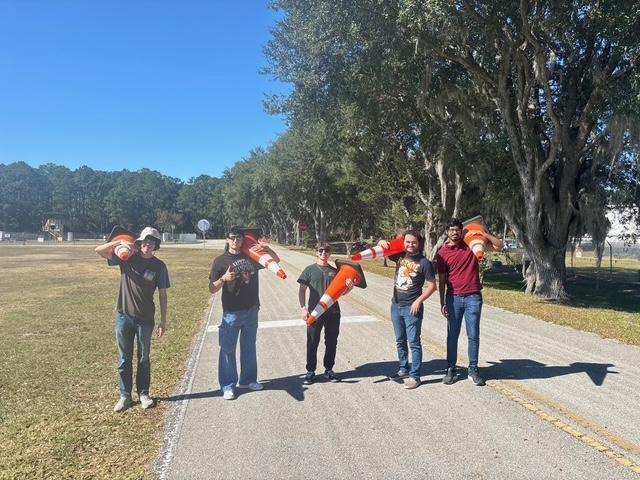
Alongside these critical decisions, we continued to perform field testing, this time atop Garage 14 at UF using our current testing prototype (AWR1843AOP-based). This time, we set up cones to simulate lane boundaries and drove a car on multiple sides. This setup increased the volume and variety of data that will be passed on to the software team to further help refine our clustering, tracking, and ultimately, threat detection logic.
Overall, this week helped solidify our grounding in our technical direction and risk-management strategy in the second semester of IPPD!