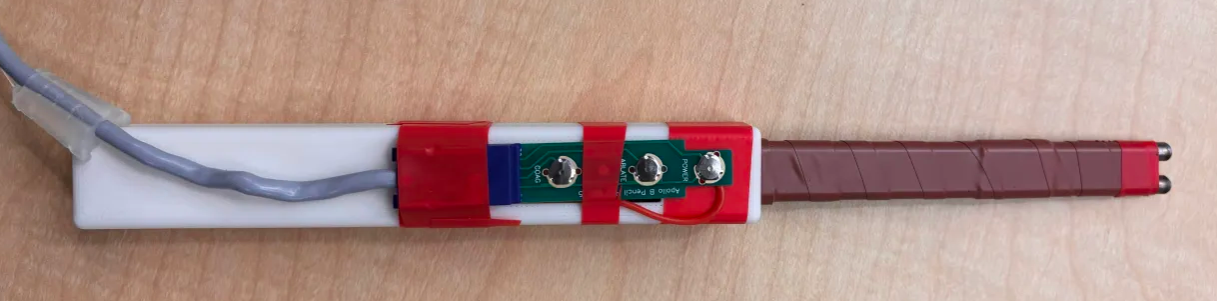
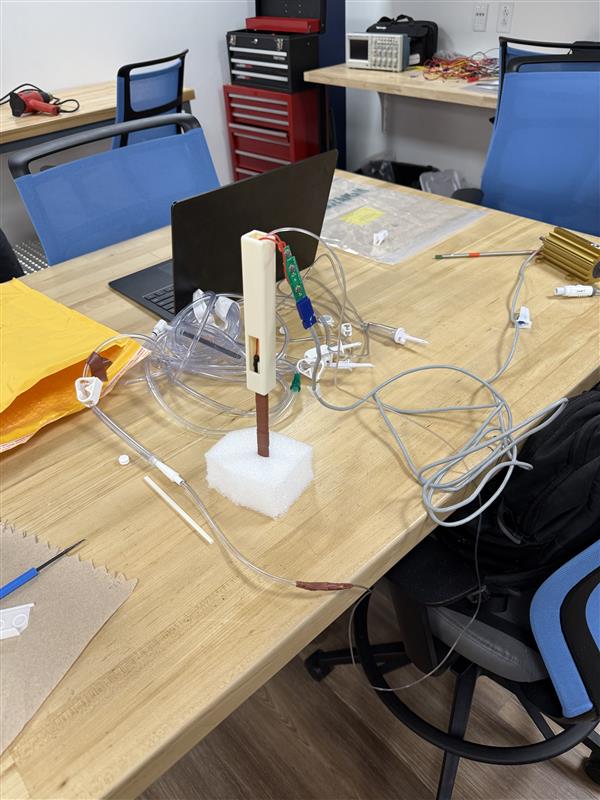
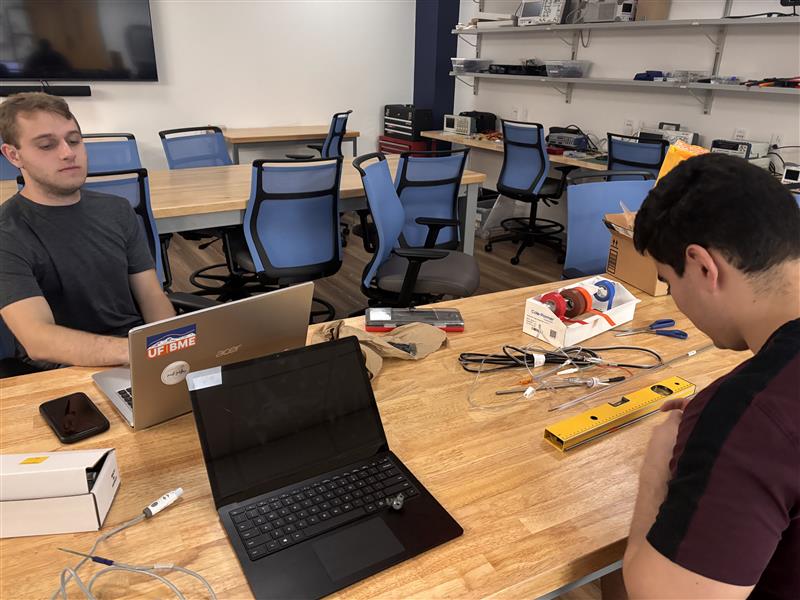
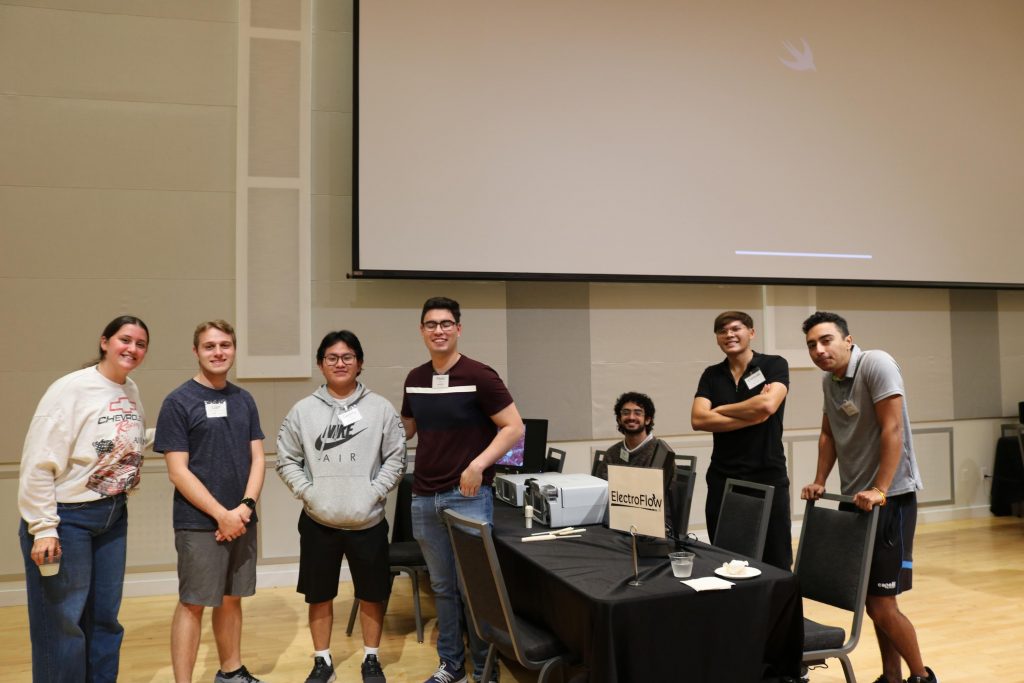
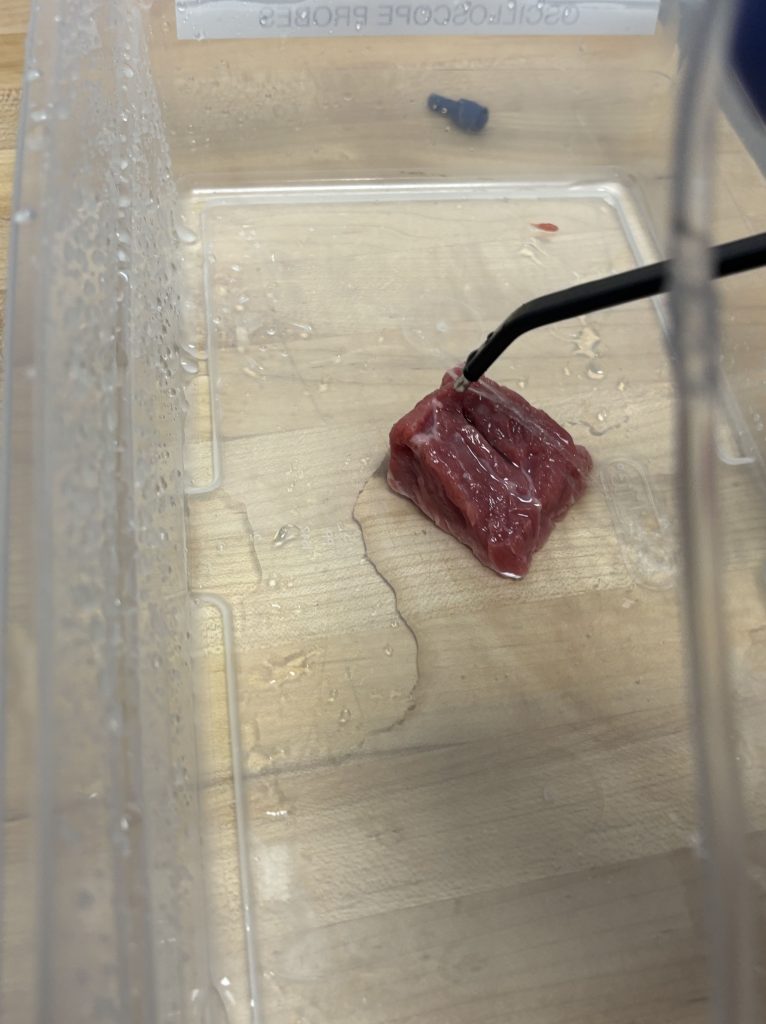
This week marked a huge milestone for our team. Just in time for the SLDR event, we assembled our first fully functioning prototype and finally got to see our design come to life. The PCB was mounted directly onto the 3D printed housing for easy access to wiring and components, which made troubleshooting and adjustments simple and fast.
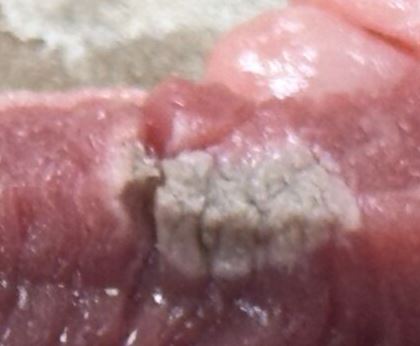
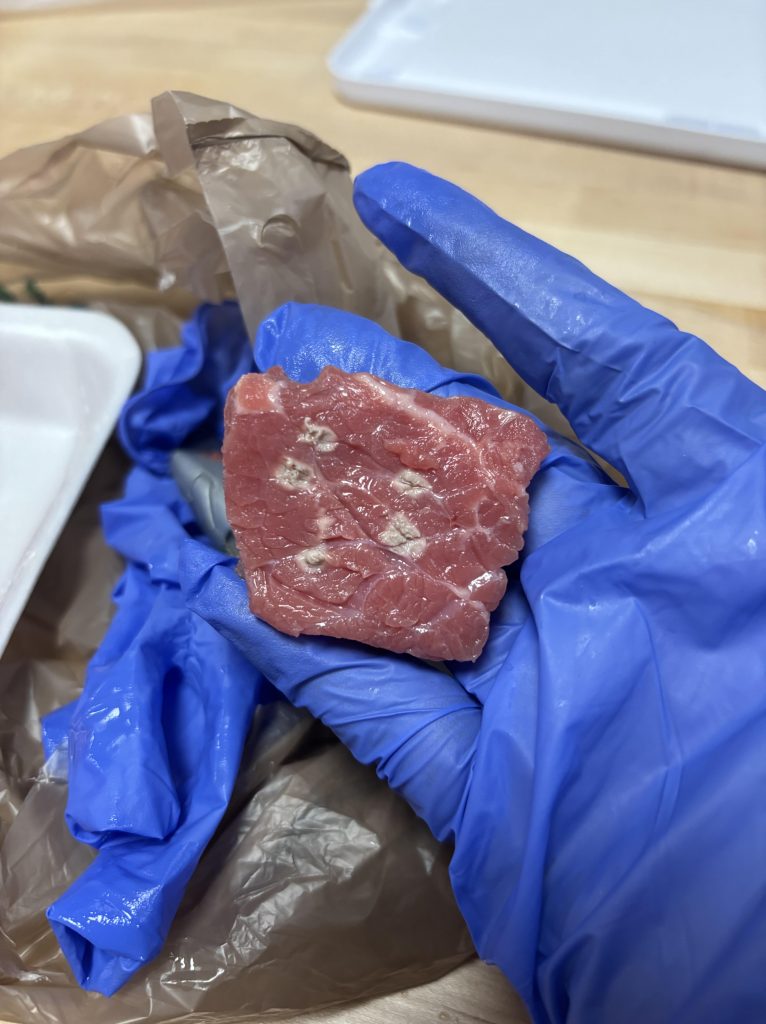
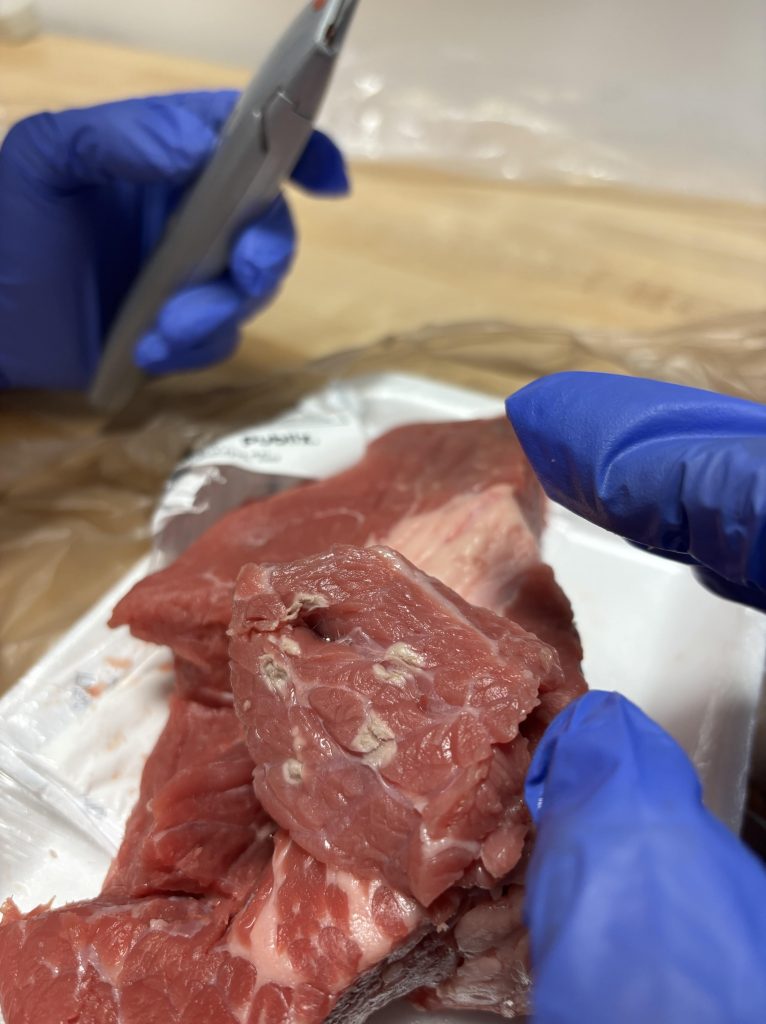
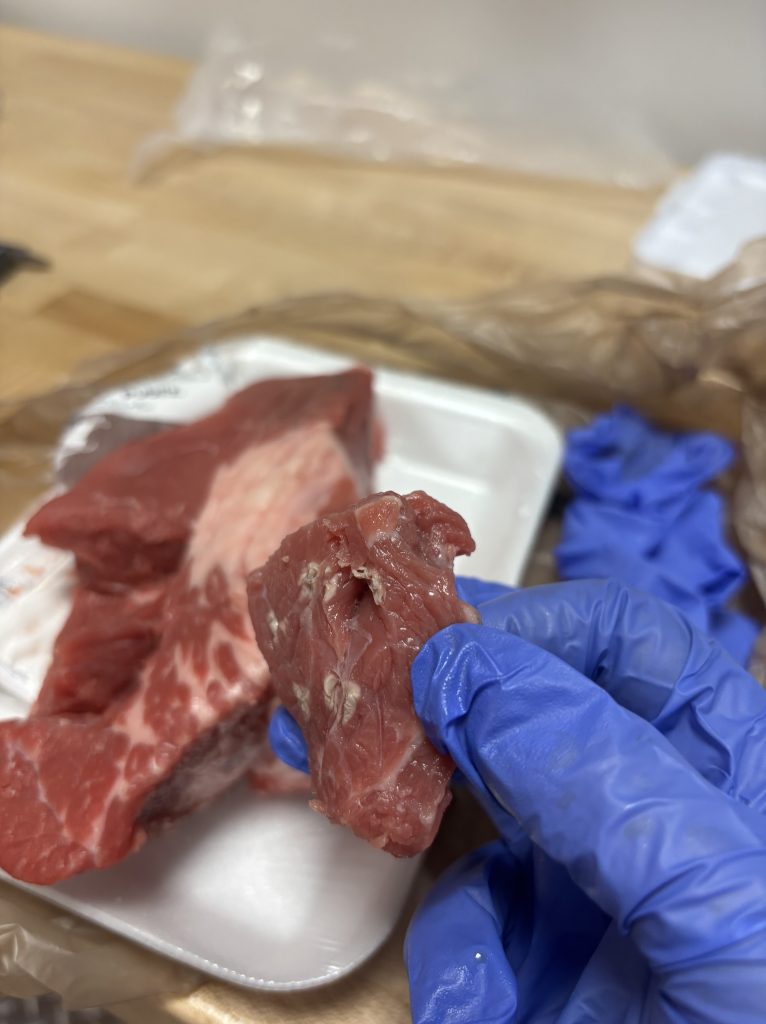
We did hit one unexpected snag. An epoxy cure mishap left our saline delivery tube fully clogged, so no fluid could flow as intended. But that didn’t stop the test. A small dab of saline applied directly to steak tissue still produced visible coagulation with an estimated depth of 4-5 mm. Even without full functionality, the result was clear and encouraging.
The device is showing promising behavior, and now we move into an exciting next phase. Our goal is to collect performance data, refine the design, and run more controlled tests to shape the next iteration. The foundation is here, and the path forward is strong.
This week, the team continued working on the prototype build and made significant progress toward completing our first functional version. After finishing most of the machining and assembly, we were able to put together the first full prototype and immediately started evaluating it. We also took the feedback from our internal SLDR and began integrating those suggestions into both the physical design and the presentation we will give on the actual review day.
Most of the technical effort this week went into assembling the prototype. With the main components now machined, we focused on putting everything together and checking whether the design adjustments from last week translated well into the physical build. While doing this, we identified a few areas, mainly related to fit, alignment, and fluid delivery, that could need revisions before the final presentation.
At the same time, we continued updating our SLDR slide deck. This involved revising our system diagrams, cleaning up sections that changed after the internal review, and making sure the presentation clearly reflects the current state of the prototype. The goal was to keep the documentation fully aligned with what we have built so far.
Some of the key takeaways from this week were:
Successfully assembling the first full prototype and using it to evaluate system fit and overall configuration.
Applying the internal SLDR feedback to improve both the prototype and the clarity of our system explanation.
Planning on testing the initial prototype once fully assembled before the SLDR
This week, our team shifted from planning to hands-on development as we began physically building our first functional prototype. After incorporating the feedback received during the Prototype Inspection Day, our focus centered on translating the refined design ideas into a physical prototype and preparing the documentation and presentation materials needed for the upcoming System Level Design Review (SLDR).
Most of our technical effort was directed toward prototype building. We began machining and assembling the primary components of the device, ensuring that the design adjustments suggested by coaches, particularly those related to fluid delivery and electrode positioning, were properly integrated.
We also dedicated significant time to developing our SLDR presentation. This involved organizing our current progress into a document, updating our diagrams, and reviewing the information from our PDR to update any decisions that we changed during the process.
Throughout the week, the team collaborated closely to maintain alignment between the build process and the system-level requirements. The main takeaways were:
Ensuring that our machining plan stays synchronized with the functional requirements established during PID.
Strengthening the clarity of our prototype for SLDR, particularly regarding fluid flow pathways and electrical integration.
Identifying potential bottlenecks in the assembly process so we can adjust the timeline before SLDR.
These insights helped guide our priorities going forward. Over the coming week, we will:
Continue machining and assembling the remaining prototype components.
Begin preliminary fit checks and dry assembly to ensure full system compatibility.
Finalize the SLDR presentation
Overall, this week marked an important transition from design refinement to physical implementation, setting the foundation for both a successful SLDR and a promising first prototype iteration.
This week, our team participated in the Prototype Inspection Day. Since the PID serves as a checkpoint for evaluating progress and direction, our goal going into the event was to communicate where we currently stand in the development process and gather useful feedback to guide the next iteration of our prototype.
We presented two forms of prototypes:
A structural prototype created through 3D printing, which allowed us to demonstrate the geometry and expected assembly of our device.
A testing demonstration video using the Smith + Nephew Werewolf probe to show the method we will use to evaluate tissue effects once our own functional prototype is ready.
Through multiple presentation rounds and Q&A sessions, we received feedback from coaches across disciplines. The main takeaways were:
Clarify some design considerations related to how we should deliver fluid flow on our device.
Refine testing methods to ensure consistent measurement of tissue effect.
Update our timeline to reflect machining, assembly, and iterative testing more precisely.
This feedback provided clear direction for our next steps. Over the coming week, we will:
Finalize material procurement for machining.
Begin assembly planning for our first functional prototype iteration.
Develop structured testing protocols to evaluate tissue effect once the prototype becomes operational.
This week, our team spent our time gathering data and a first stage structural prototype of our device for the upcoming Prototype Inspection Day on Tuesday, November 4th. In class, we were provided all the important details of this benchmark event, which are summarized below:
15 minute presentation to a set of 2 judges + a 10 minute Q&A
Repeated presentations 3 times
Take notes in the presentations to keep track of feedback
Content
Define the goal of the prototype
Define the uses of the prototype
Define the type(s) of the prototype
Define the hypothesis associated with the prototype
Define the experimental plan with the prototype
Create and present a schedule for procurement, construction, and testing of the prototype and/or future prototype iterations
Our Plan
In discussing what we wanted to present in our PID presentation, we had to base the decision on what we had accomplished thus far. Since we had developed CAD drawings of our first iteration of the functional prototype (our deliverable to Arthrex), we decided that one prototype that we could present is a structural prototype of what we expect our first iteration to look like once we receive materials and complete the machining and assembly process. Therefore, we 3D printed these structural drawings to present at the PID.
To demonstrate functionality (provide a version of a functional prototype), we decided to use our designed testing methods for our future prototypes on the competitive market on the surgical device market, the Smith + Nephew Werewolf Probe. We did this for a few reasons. First, as discussed last week, we wanted to demonstrate that we could electrically map wire layout and PCB design of an RF Hemostasis probe to the AR9800, per the Arthrex scope of work. However, in order to go from there, we tested this device on meat to see the type of tissue effect that would be achieved with the design and materials used by the competitor. As we will discuss in our PID, the evaluation of future functional prototypes will be determined by metrics such as the depth of penetration of tissue effect and the area of spread on the surface of that effect. These will be measured with AR9800 power level as the independent variable and the time of coagulation as a constant.
After our team returned from the PDR in Naples last week, we got to work right away on prototype plans for a functional device. The first thing we decided to tackle was deliberating through the mechanism of action of RF probes. We did this by attempting to rewire the competitor device which achieves a similar outcome to our design to the power supply that our device must be compatible with. This was suggested to us by multiple engineers at the PDR to develop a knowledge of how mechanical components interface with electrical components. We set out to achieve the following goals
Successfully reroute the Werewolf Probe to the AR-9800 power console to deliver RF energy at some relevant current
Map each crucial wire in the Werewolf Probe and identify similar wires in the i90 probe
Examine the power adaptor for each probe and compare them with each other
Achieve a sense of familiarity with the electrical components of the Werewolf device
Begin discussion of electrical mapping of our first prototype iteration
Over the course of multiple days, our team was able to achieve all of these goals this week. We originally also wanted to receive voltage and current readings as outputs from the device at different AR-9800 modes, but this proved difficult. We originally thought this was because our equipment was faulty, but later realized during our meeting with our Liaison that it was due to lack of a load resistance to accommodate the measurement. This informed our next steps for the coming week:
Curate a list of materials for our first functional prototype and order them
Activate saline delivery of the Werewolf probe in tandem with active coagulation from the AR-9800
Measure voltage and current outputs from the Werewolf device at AR-9800 coagulation and ablation settings
Perform concept testing on steak with Werewolf device to get a baseline of power level response from coagulation probes
Document testing process and results, which will help inform how our to test our own device
Three of our team members, Mike, Geremy, and Liam deconstructed the Werewolf probe and exposed the wiring in the power cable.Each probe has two chords protruding from it: one for electrical power (black) and the other for saline flow (gray).As we came to conclusions about the function of individual wires, we kept track of them on this whiteboard.Mike connects oscilloscope probe and attempts to measure a voltage across the bipolar electrodes upon activation of the device.A major achievement this week was the successful ability to power the Werewolf probe using the AR-9800 by severing and reconnecting the cables of the Werewolf and i90.We reached a standstill when all voltages that were read on the oscilloscope were unrealistically high, which demonstrated a flaw in our measuring technique.After setting the proper magnification scaling to match the oscilloscope probe that we had been using, we received more realistic values for voltage (see “RMS” or Root Mean Squared Voltage). However, we tested this with multiple oscilloscope probes and each rendered very different results, which caused us to second-guess our measuring process. Later, we concluded that a load resistor would be necessary to get a proper reading.
This week ElectroFlow completed a successful Preliminary Design Review with an audience of engineers and project managers at Arthrex headquarters in Naples, FL! This experience was greatly beneficial to our team, as it provided much clarification on more specific aspects of our project and allowed us to receive feedback on our current project plan and established structures. Find more details about our trip below!
Go Gators @ Arthrex!ElectroFlow team with our amazing Arthrex Liaison – Coleman!A portion of our day at Arthrex was dedicated to a deconstruction of the market competitor device with our liaison to discuss the importance of certain design features.On Sunday evening, we had a chance to go out to eat as a team at a local restaurant in the Naples harbor!As you can see, the internal structure of the competitor device is fairly simple, with only a small PCB, saline tubing fixture, and probe shaft.We were able to tour Arhtrex’s beautiful campus with many outdoor hotspots such as this. We were shocked at how much it felt like a college campus!An image of the amazing Arthrex Theatre Studio, where they produce professional-grade marketing and clinical videos for their company and clients.A team debrief after our presentation and discussion of next steps with our liaison.
Well we’re approaching the end of Phase 1 of our project: the Preliminary Design Review! On Sunday 10/12, all 7 team members will be traveling to Naples, FL to meet our liaison (Coleman), Arthrex clinicians, other Arthrex engineers and co-op students, and project management staff. We will be given a tour of the facilities, a clinical demonstration of current and related Arthrex surgical devices, but most importantly, we will be presenting our current design ideas and how we have come up with them. This is a critical point for the direction of our project, as the feedback we receive will go a long way to provide clarity for our first prototype iteration. We are excited to meet the Arthrex team!
How we’ve prepared:
We spent multiple days in the lab this week to discuss and rank design ideas for our initial prototype iterations. These images show some team members opening up and analyzing the component and system-design of a comparative product to our team’s. We did this to generate concepts that would be featured in our Decision Matrices which helped us choose our ideas.
On Tuesday 10/7/25, we gave a practice PDR which was reduced in size and meant for the purpose of peer review. In attendance was 3 other IPPD teams who provided us with feedback, an IPPD staff member who scored and coordinated our presentation delivery, and our coach, Shuo Wang, who was there to confirm our preparedness for the actual PDR the following week. The presentation was great, and we received great feedback on where to improve with the presentation before we head to Naples.
We had one final meeting with Coleman, or liaison, before heading to Naples. In that meeting, we confirmed some figures that we are preparing to present, received clarification on our Design Traceability Matrix, and discussed the logistics of our trip. Overall, the team is ready to meet everyone in Naples and receive good perspective on our next steps. After the trip, we will move into project phase 2: Building!
This week, our team has been focused on three major project aspects:
PDR Presentation
In just about 1 week, our team will be headed to Naples, FL to deliver the Preliminary Design Review to Arthrex employees (both clinical and engineering)! We are in the midst of preparing a presentation of our design considerations and ideas. The goal of the presentation is to receive feedback on which concepts our design will be feasible (both in functionality and testing) and which will not. As you can see below, the presentation will be via PowerPoint, and we will divide the delivery among the team members. This upcoming Tuesday, 10/7, our team will be delivering a mock PDR presentation (shortened) to our IPPD class and coach in lecture. This will be another great way to receive feedback before our main presentation on 10/13.
Here is the title slide for our PDR presentation!
Design Architecture
This week, we also completed a product architecture schematic. This helped us identify each physical component of the design we will be developing and the interactions between them. This included a physical component schematic, a table of component features, a clustered component overview, fundamental and incidental interactions of components, a 3D diagram (pictured below), and a narrative on changes in our approach from concept generation.
This is a 3D diagram of the component interactions in our current design.
Design Traceability Matrix
As a part of the Arthrex product design standards, a design traceability matrix is required for any new device in development. Our company liaison sent us a document template and guided us through the proper use of this technical strategy document. As you can see below, the document highlights user needs and categorizes design inputs based on those user needs. For the protection of IP, we have not published items from this document. However, the template can be seen below.
This is the template for our team’s Design Traceability Matrix.
Week 4 is in the book! We have secured our travel to Naples to visit Arthrex in the middle of October; we’re very excited to meet the engineers and explain our project! Furthermore, we have received probes from Smith and Nephew, who are a competitor to Arthrex, to help us start visualizing what a final product will be. We also have access to Arthrex i90 probes, so some of our ideas on ergonomics can be confirmed. A lot of discussion has been done by us about our concept generation and the new project timeline; we feel that the intermittent deliverables are starting to materialize!